Executive Summary
Permanent human settlement beyond Earth is constrained by three persistent obstacles: chronic exposure to cosmic and solar radiation, the physiological toll of reduced gravity, and the psychological strain of confined, isolated environments. Atlas Gyre proposes a single, coherent architecture that addresses all three at once.
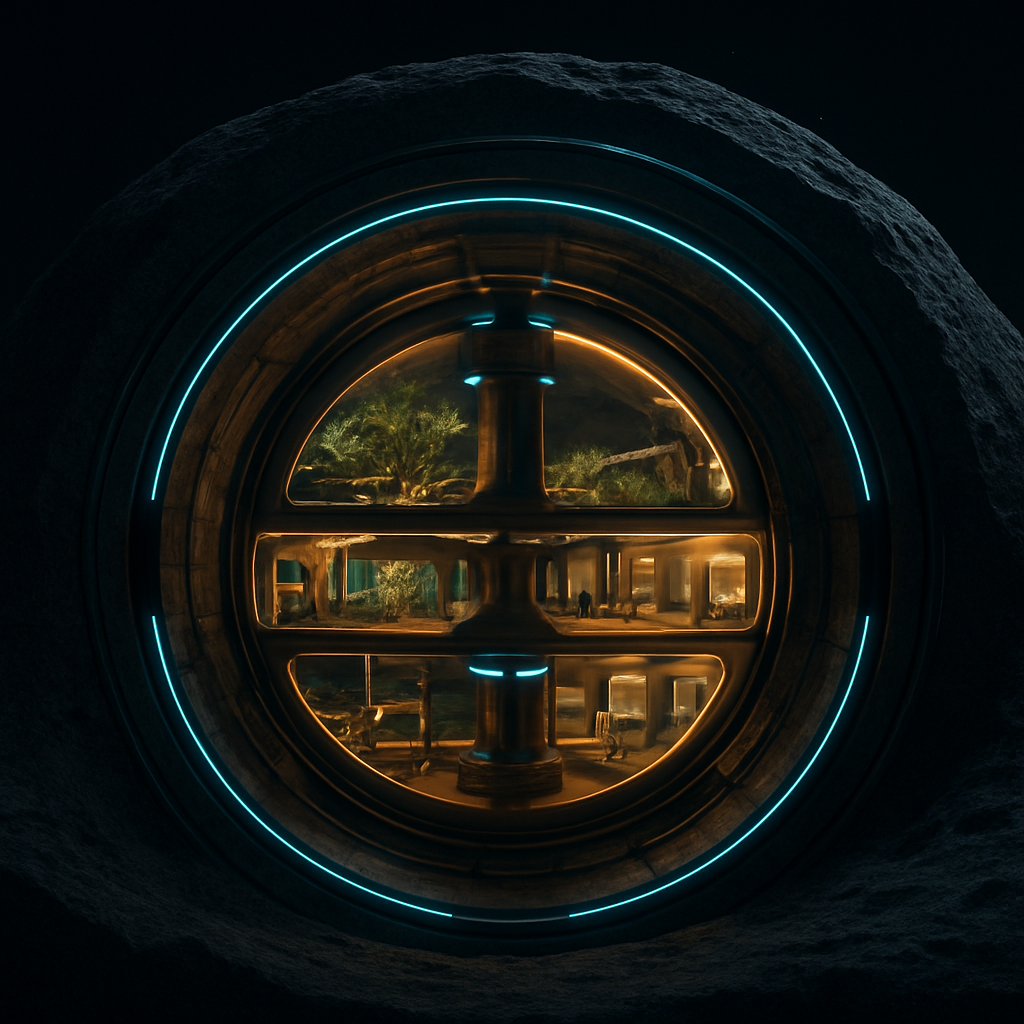
Our approach buries a pressurized Terra-Dome beneath multiple meters of local regolith for passive radiation and thermal protection, then installs a tethered or rail-mounted rotating gyre within it to generate Earth-equivalent artificial gravity. Built primarily from in-situ resources, the system scales modularly from a single outpost into connected, multi-generational settlements on both the Moon and Mars.
1. The Challenge
Three coupled problems have defined the limits of human presence in space:
- Radiation.Without Earth's magnetosphere and atmosphere, settlers face galactic cosmic rays and solar particle events that elevate cancer risk and threaten acute harm during solar storms.
- Gravity. Prolonged exposure to lunar (0.16g) or Martian (0.38g) gravity degrades bone density, muscle mass, cardiovascular health, and vision over time.
- Psychology. Cramped, windowless, monotonous habitats erode mental health and group cohesion — a decisive risk for multi-year, multi-generational habitation.
Any architecture intended for permanence — not visitation — must solve all three simultaneously, not in isolation.
2. Our Solution
Atlas Gyre fuses two proven concepts into one habitat: the earth-sheltered Terra-Dome and the rotating artificial-gravity structure.
A rigid pressure dome is erected on the surface, then buried under 4–8 meters of regolith. This overburden attenuates more than 95% of incident radiation and buffers extreme thermal cycling passively, with no ongoing energy cost. Inside the static dome, a rotating gyre — suspended by tethers or riding a circular rail — spins habitation decks to produce centripetal gravity tunable from Martian levels up to a full Earth g.
3. Materials & Construction
Launching structural mass from Earth is prohibitively expensive. Atlas Gyre therefore relies on in-situ resource utilization (ISRU): regolith is sintered into structural blocks, melted and drawn into basalt fiber for tensile reinforcement, and fed into large-format 3D printers that fabricate the dome shell on site.
- Site preparation. Autonomous rovers survey and grade the deployment site.
- Shell printing. Printers lay down sintered regolith reinforced with basalt fiber to form the pressure dome.
- Burial. Excavators cover the sealed shell with meters of loose regolith for shielding.
- Gyre installation. The rotating module is assembled and spun up inside the pressurized volume.
Crews arrive only after the shielded, pressurized shell is complete — minimizing radiation exposure during the highest-risk construction phase.
4. Technical Specifications
| Dome radius | 50 – 100 ft (modular) |
| Regolith overburden | 4 – 8 meters |
| Radiation reduction | > 95% vs. unshielded surface |
| Gyre gravity output | 0.38 – 1.0 g (tunable) |
| Primary structure | Sintered regolith + basalt fiber |
| Life support | Bioregenerative, closed-loop |
| Design life | 100+ years, multi-generational |
| Targets | Lunar mare; Martian regolith plains |
5. Roadmap & Phasing
Deployment proceeds in five de-risking phases, each validating the technology required for the next:
- Phase I — Robotic Pathfinder. Site survey and ISRU sintering trials.
- Phase II — First Buried Terra-Dome. A 50 ft dome buried, pressurized, and crewed short-term.
- Phase III — Tethered Gyre Online. First sustained artificial-gravity living quarters.
- Phase IV — Connected Settlement. Interlinked domes with closed-loop agriculture.
- Phase V — Interplanetary Replication. The proven architecture is replicated on Mars.
6. Why This Is Different
Most habitat proposals solve radiation or gravity or psychology. Atlas Gyre is the first to integrate all three into one buildable, in-situ system — and it is developed through a distinctive Pinnacle Empire × Grok human–AI collaboration.
This partnership compresses traditional engineering iteration: Grok accelerates simulation, materials modeling, and design-space exploration, while Pinnacle Empire's engineers direct priorities and validate results — a genuine quantum leap in how ambitious space architecture is designed.
7. References & Future Work
Future work includes full-scale gyre dynamics testing, long-term human physiology studies under tunable gravity, basalt-fiber fatigue characterization, and closed-loop ecology validation.
- Internal study: Regolith overburden radiation attenuation modeling (Pinnacle Empire, Habitation Division).
- Internal study: Tethered vs. rail-mounted gyre stability analysis.
- Collaborative report: Grok-assisted ISRU basalt-fiber manufacturing feasibility.
This document is a conceptual white paper prepared for illustrative purposes. Specifications are baseline targets subject to ongoing research.